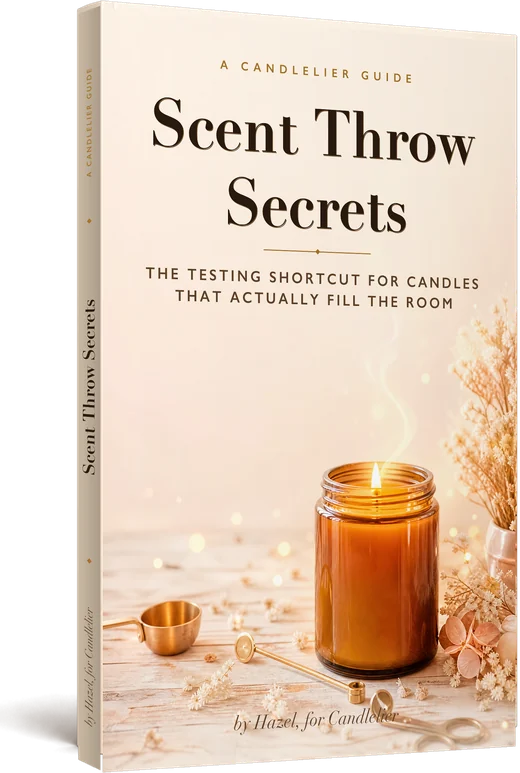
You poured it, you lit it, and the room stayed empty.
You leaned over the cold jar and the scent was gorgeous. You got it home, you lit it, you waited, and nothing came. The room just stayed empty.
Maybe your cold throw is great and your hot throw is nothing. Maybe it barely smelled, or had no smell whatsoever, and you sat there sure you had done something wrong.
So you did what everyone does. You bought new wicks. You poured in more oil. You tried every temperature you could find and ended up more confused than when you started, with a counter full of testers that all cost money you felt.
I know that feeling, and it is the exact thing that makes people quit candle making. So before you buy one more tester, start here.
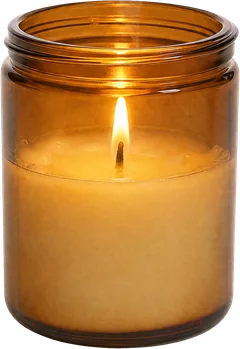
The cold jar and the lit candle are two different tests.
Your candle makes two separate smells, and each one comes from a different place.
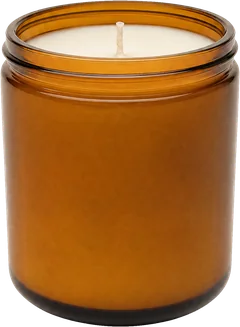
Cold throw is how it smells unlit, sitting in your hand. It rides on the light, bright top notes that lift into the air on their own. That is why the jar can smell incredible.
Hot throw is how it smells once it burns and the room fills up. That one leans on the heavy base notes, and those stay locked in the wax until heat releases them.
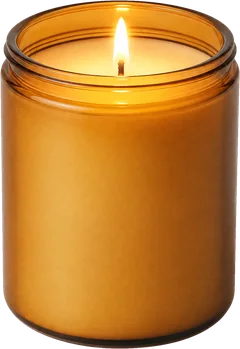
So a candle packed with bright top notes smells wonderful cold and then goes quiet once it burns, because the notes that fill a room were barely in there to begin with. That gap between the gorgeous jar and the quiet burn is the whole mystery, and once you see it, you can fix it.
Find which of the 8 reasons is behind your weak throw.
Your heavy scent gets lost in only a handful of places on its way out of the candle. Scent Throw Secrets walks you through all 8, so you stop guessing and know exactly which one is yours.
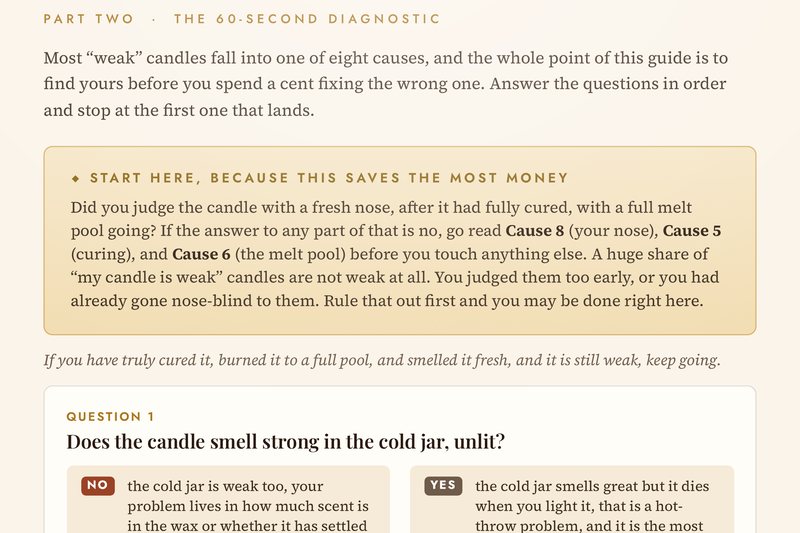
- The wax you poured. Soy, the one almost every beginner gets pointed toward, is the weakest thrower of the common waxes. If you poured straight soy the right way and still got a quiet candle, the wax was the limit the whole time.
- Too little fragrance, or too much. There is a real window, and past the top of it more oil gives you a weaker candle for more money.
- Cheap oil that was cut with filler. Some of that percentage you measured so carefully was never fragrance at all.
- Oil added at the wrong temperature. Add it too cool and it never fully blends in, then seeps back out later and takes your throw with it.
- A candle judged before it cured. You smell a day-old tester, your heart sinks, and you fix a candle that was never broken.
- A wick too small to open a full melt pool. The scent was in there the whole time. The melt pool just never got wide enough to let it out.
- A candle too small for the room. A wick that fills a cozy bedroom can vanish in a big open kitchen, and that is not a flaw.
- Your own nose going blind to it. After a while you stop noticing a scent you live with, so the person judging the candle is the one who can no longer smell it.
14-day money-back guarantee. If it does not help your candles, email Hazel and get every cent back.
What makers keep saying about weak throw
You are not the only one. These are real makers describing the same weak-throw problem this guide fixes, in their own words.
"I get a great scent throw when I'm making the candle but when burning it, I smell nothing."
"my house smelled great all night, but the candles were boo boo when I went to burn them!"
"I have no smell what's so ever."
"when I made my first candle and couldn't smell the fragrance I was so frustrated that I almost gave up making candles"
"I tried all the temperatures I could find on the Internet, I added less fragrance oil, more fragrance oil ... experimented with all kinds of wicks"
"My issue has been the expense of testing and it does not work the same each time."
Every cause comes with the exact number that fixes it.
You came here because the rest of the candle world made you pay to find out the real number. This guide just gives it to you.
For every one of the 8 causes, you get the fix and the number that goes with it. The fragrance percentage to start at, weighed on a scale, and where your wax's real ceiling is actually written down. The temperature to add your oil, and how long to stir it. The burn time that opens a full melt pool on the first light, and the wick trim that keeps it even. The cure time for your wax, so you stop throwing out candles that just needed a week on a shelf.
The real number changes from wax to wax, so the guide gives you a starting number and then shows you how to find your own wax's exact one. Anyone who promises a single magic number for every wax has not poured enough candles.
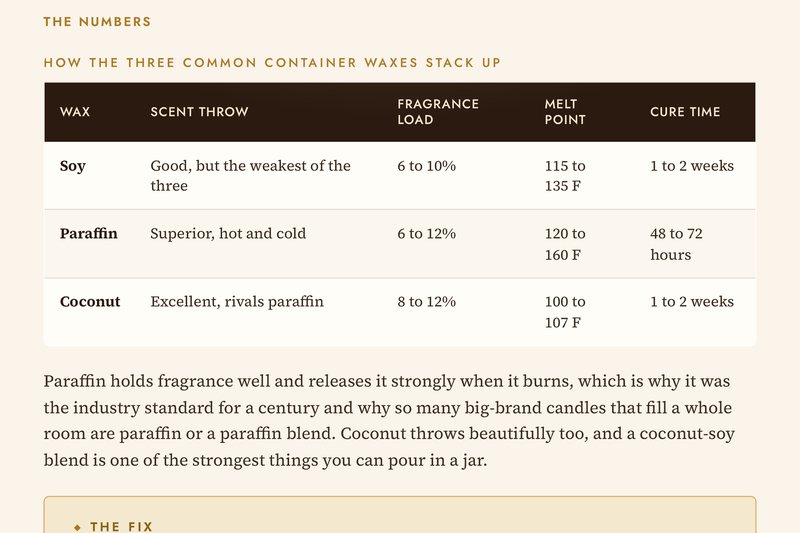
A short testing method that saves your wax and your money.
The reason testing hurts is that you change three things at once, get a weak candle, and have no idea which change did it. So you test again. And again. And the cost adds up fast.
The guide hands you a small-batch testing method that changes one thing at a time, in the right order, so a handful of candles tells you what a mountain of them used to. You find your answer and you stop pouring money onto the counter to get it.
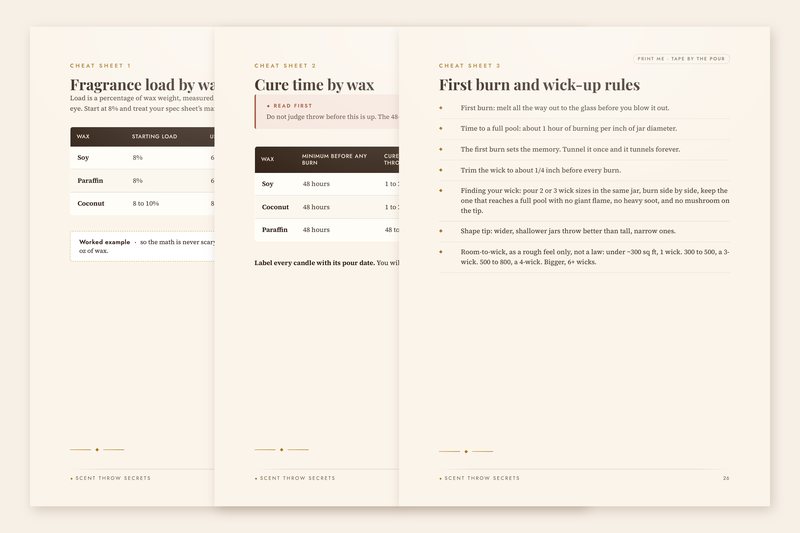
Print the charts and stop looking it up every pour.
The back of the guide is built to live on your workbench. You get printable cheat sheets you can pin up and use mid-pour:
- Fragrance load by wax, so you know the percentage to weigh before you start.
- Cure times by wax, so you know the day it is actually ready to judge.
- First burn rules, so your very first light opens a full pool instead of a tunnel.
- A symptom-to-fix troubleshooting tree. You find the symptom your candle is showing, read across the row, and it points you straight at the cause and the fix.
This is for the maker whose candles smell weak and wants that fixed.
This is for you if:
- You pour candles at home as a hobby or a small side business, and the scent is letting you down.
- Your candle smells great cold and weak when lit, or it barely smells at all.
- You are tired of advice that contradicts itself and testing that keeps costing you.
- You have never heard the words hot throw and cold throw and thought this was only for pros. It is not. The guide explains every term in plain words the first time it uses it.
This is not for you if:
- You want a full start-to-finish beginner course on making your first candle. This fixes scent throw. It is not a how-to-pour-your-first-candle guide.
- You are looking for scent recipes or fragrance blends to copy. This gets your own scents to throw strong. It does not hand you a list of blends.
- You want a guide to pricing or selling candles. This is about the candle, not the business.
- You want a finished formula with zero testing. This cuts your testing down to a short, cheap batch, and a little testing is still how you land it.
One guide, yours the moment you pay.
$17
Scent Throw Secrets is a 17 dollar guide. It is an instant download. The moment you pay, your download link opens on the next page and also lands in your inbox, so you can read it on your phone at the workbench or print the cheat sheets on the spot. It is a PDF, and it is yours to keep.
14-day money-back guarantee. If it does not help your candles, email Hazel and get every cent back.
The questions makers ask before they buy this.
- Will this work for my soy wax?
Yes. Soy is the weakest thrower of the common waxes, so it is exactly the wax this guide spends the most time on. You will learn how to pull as much scent as soy can give through your pool, your load and your cure, and how to tell when the wax itself is your ceiling.
- What does 8 percent even mean? Is that like eight drops?
It is not drops. Fragrance load is a weight. It is the weight of the oil as a percentage of the wax, measured on a scale. The guide shows you how to weigh it, with a worked example, so the percentage finally makes sense and you stop eyeballing the most expensive thing in the jar.
- Do I really add the oil to hot wax? I thought the heat burns the fragrance off.
That fear is costing you throw. The number people are scared of is the flash point, and that is a shipping and storage number, and it says nothing about the temperature you add your oil at. Adding your oil too cool is what actually hurts you. The guide gives you the add temperature and the stir time, and explains why.
- My candle smelled like nothing the day after I poured it. Is it ruined?
Almost certainly not. A candle keeps curing for days, and the scent keeps settling in the whole time, so a day-old tester is not finished. The guide gives you the cure time for your wax, so you stop writing off candles that just needed a week on a shelf.
- I can't smell my own candles anymore. How am I supposed to test the throw?
That is your nose doing it, and the candle is probably fine. It switches a steady smell off within about two breaths, so the person leaning over the candle all day is the one person who cannot smell it. The guide shows you how to reset your nose and judge throw the way a visitor walking in the door would.
- Isn't the fix just adding more fragrance oil?
It is the first thing everyone reaches for, and it usually makes things worse. Past what your wax can hold, the extra oil separates out, seeps to the surface and can clog the wick, which shrinks the pool and the throw. The guide shows you the real levers so you stop paying more for a weaker candle.
- How do I get it once I pay?
Right away. Your download link opens on the thank-you page the moment you pay, and the same link is emailed to you. It is a PDF you can read on your phone or print.